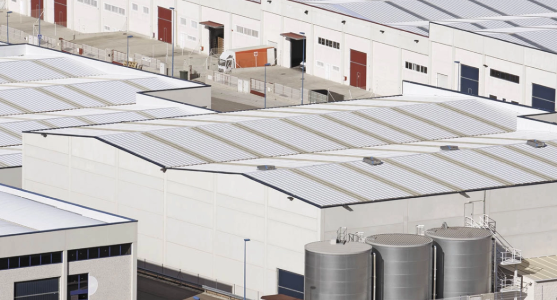

Jalisco’s industrial real estate market has maintained an average annual growth rate of 20% over the past three years, outperforming the mid- and high-end residential segments. This momentum has been driven by the expansion of companies already operating in the state, domestic investment, and the development of logistics infrastructure.
The president of the Mexican Association of Real Estate Professionals (AMPI) Guadalajara, Jahaziel Castañeda, told El Economista that the industrial sector has become the most dynamic segment of the state’s real estate market. However, he warned that the uncertainty surrounding the review of the United States–Mexico–Canada Agreement (USMCA) and the United States’ tariff policy represents one of the biggest challenges to maintaining this growth during the year.
“In the industrial sector, we have been growing at around 20% over the last three years naturally. The challenge is ensuring that all the uncertainty generated by the USMCA review and the United States’ tariff policy does not slow that growth this year,” he said.
Industrial Sector Outpaces Residential Market
Castañeda González explained that, in percentage terms, the industrial sector has grown faster than the mid- and high-end residential housing market. Only the middle-income and affordable housing segment has experienced comparable growth.
“Industrial growth has accelerated more, percentage-wise, than other real estate sectors. For example, compared to the mid- and high-end residential market, the industrial sector has experienced stronger growth,” he said.
According to the AMPI Guadalajara president, the strength of Mexico’s domestic market has helped cushion the effects of commercial uncertainty between Mexico and the United States. He explained that, following the implementation of U.S. tariffs, industrial real estate development continued to be driven primarily by domestic investors and by expansion projects from foreign companies already established in Mexico.
“What kept industrial real estate development moving was the domestic market and the expansion of foreign companies that were already here. Those companies have also experienced strong growth and continue investing in our country,” he emphasized.
Infrastructure Strengthens Jalisco’s Competitiveness
Castañeda highlighted that the modernization and expansion of the Guadalajara International Airport, together with the development of industrial real estate projects in the surrounding area, have strengthened Jalisco’s competitiveness in attracting new investment.
He also announced that AMPI Guadalajara will participate in trade missions to the United States to promote the state as a destination for new industrial investments, taking advantage of its available infrastructure and capacity to accommodate projects of various sizes.
Industrial Cities and New Development Models
For her part, AMPI National President Jenny Althair Rivas Padilla stated that the growing demand for industrial space is reshaping Mexico’s investment landscape, as states such as Querétaro, Guanajuato, and San Luis Potosí are facing limited land availability for new developments.
She explained that although Querétaro and Guanajuato have long been among the country’s leading destinations for business investment, the shortage of available land has encouraged the search for new expansion models.
As an example, she highlighted integrated developments under construction in the State of Mexico, particularly in the Toluca area, where industrial complexes are being designed to include housing and commercial areas in order to reduce commuting times and lower workers’ living costs.
“They are developing integrated, master-planned projects that are essentially industrial cities with housing, commercial areas, and all the necessary services, allowing employees to live closer to their workplaces. This reduces transportation needs, lowers living costs, and reflects a model that is already well established around the world,” she explained.
Rivas Padilla added that San Luis Potosí has also begun expanding its industrial offering into neighboring municipalities through planned developments and investment incentives. The goal is to prepare the region to attract new companies establishing operations in Mexico and to consolidate new industrial hubs with sufficient infrastructure to meet future demand.
Source: eleconomista