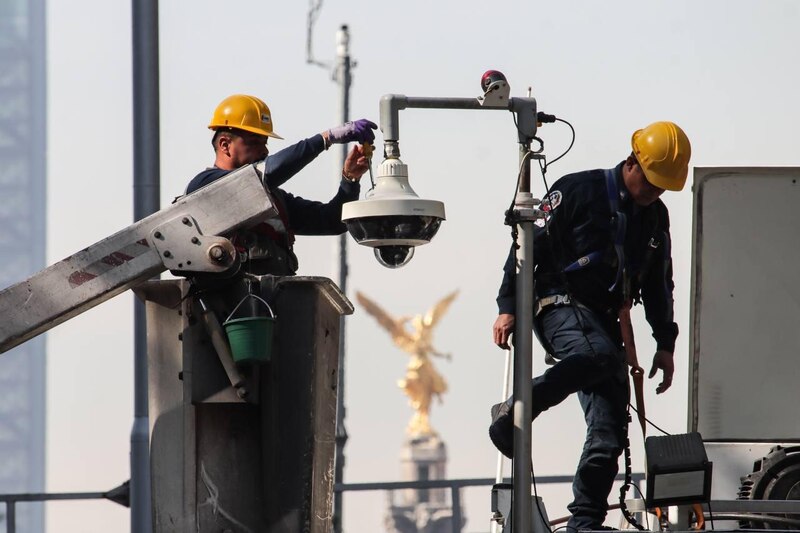
Mexico City is the most robust video surveillance institution in the Americas, and as has already begun to happen, private sector and the general public can offer their support by purchasing their own video security equipment. This capital’s track record is an indispensable benchmark. With varying nuances and scope, other states in the country, such as Jalisco, have decided to invest in the construction of increasingly powerful C5s.
While the capital is poised to close 2025 with more than 113,000 cameras, Jalisco plans to install just over 10,000. These will presumably be added to the 7,000 cameras already in place in the state governed by Pablo Lemus, who will invest more than 6 billion pesos over several years, including a new Command and Control Center. In Mexico City, 30,000 new cameras will be added with an investment of less than 400 million pesos.
The western state, from which one of the two most dangerous organizations in our country originated, currently represents barely a tenth of the capital’s power, which does not mean ignoring the very considerable progress toward a global trend in security: video surveillance as an investment and public policy variable within the framework of any strategy to protect the integrity of people and their property.
China accounts for more than half of the world’s security cameras; London, a pioneer in mass deployment since the 1990s, consolidated a system that encourages more controlled behavior and reduces opportunities for violations. Singapore, with its Smart Nation project, has interconnected cameras, traffic sensors, and databases to regulate everything from mobility to waste management. New York uses predictive algorithms that cross-reference video surveillance information with citizen reports to anticipate risk points.
Mexico has entered that race.
In 2018, the national capital had only 15,310 devices. The drive of now-President Claudia Sheinbaum as local leader generated the transformation. In six years, her administration more than fivefold increased the number of cameras, closing her six-year term with more than 80,000 devices. The C5 became the brain, eyes, and digital heart of security, capable of coordinating police response, emergency response, mobility management, and inter-institutional coordination.
The Mayor, Clara Brugada, decided to expand this vision, reinforcing the centrality of the Command, Control, Computing, Communications, and Citizen Contact Center (C5) in urban life. Last week, she presented “Ojos que Te Cuidan” (Eyes that Watch Over You), the program to acquire 15,200 totems equipped with 30,400 cameras, which will be installed before the end of this year.
Jalisco is observing this model and is beginning to take its own very significant steps. The project presented by Governor Lemus to build a C5 with 10,500 cameras is progress in the right direction. 21st-century security requires local governments to invest in digital infrastructure to address risks: “a virtual wall in the Guadalajara Metropolitan Area,” the president defined.
The contrast between Ojos que Te Cuidan (Eyes that Watch Over You) and Escudo Jalisco is still striking: while in Mexico City the system has matured for seven years, in Jalisco the articulation process is just beginning. The challenge is not to limit itself to the simple acquisition of devices, but to achieve genuine institutional integration, coordination with prosecutors’ offices, municipal, state, and federal police forces, and the training of personnel who, beyond algorithms, remain the indispensable human link for translating information into action.
Source: cronica