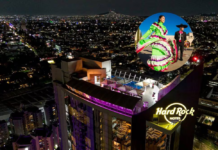
When the sun sets and the lights come on, Guadalajara reveals its other side. The city that bustles with traffic and activity during the day transforms into a different territory: more intimate, more sensorial, more alive. Shadows join forces with light to draw new shapes on the buildings, to outline monuments we already know, but that now seem different. It is then that the city invites us to be rediscovered.
The heart of this transformation is Paseo Alcalde, one of the greatest urban successes of recent years. At night, this pedestrian walkway fills with strollers, couples, families, and musicians. Streetlights illuminate trees and fountains that whisper in the darkness, while historic monuments take center stage in the warm light. The Cathedral, with its inverted towers like gold-plated calla lilies, dominates the scene. But what was once just a temple now becomes a spectacle: the nighttime mapping projected onto its façade draws crowds amid kaleidoscopes of color, historical scenes, and cultural elements made possible by light.
At the Cruz de Plazas, children play among dancing fountains, seniors dance danzón under dim lights, and urban astronomers set up telescopes to observe Saturn and Jupiter from the heart of the city. Everything vibrates to a different rhythm. The Plaza de Armas and Plaza de la Liberación, the Rotunda of Illustrious Jalisco Residents, and even the benches in the Reforma Garden with its illuminated carousel, tell stories that can only be heard at night.
Further afield, the Expiatory Temple, with its stained-glass windows shining from within like floating jewels, and the Escorza Street esplanade become community spaces: there are snacks, books, secondhand clothing, musicians, and long conversations. Here, light not only beautifies: it creates community.
The Museum of Arts (MUSA), on Avenida Juárez, also comes alive at night. Strategically lit, it projects messages of inclusion and social struggle. Its walls are dressed in purple on March 8th or rainbow colors during LGBTQ+ Pride, demonstrating that light can also be a symbol.
And if you continue through Vallarta toward Chapultepec, you’ll find a nightlife corridor that combines alternative culture, art markets, urban cuisine, and partying. Rows of spotlights, warm terrace lights, and illuminated murals turn this walk into a constant carnival, where bohemian, modern, and popular culture intertwine.
There are also the icons: La Minerva, a stone watchtower that shines like a pagan deity in the center of a city that never sleeps. Or the Matute Remus Bridge, a piece of architecture that at night becomes a light sculpture, whether you drive across it or admire it on foot.
In recent years, Guadalajara has opted for urban lighting that goes beyond functionality, but instead creates atmospheres, redefines spaces, and transforms the city into an open stage for art, encounter, and contemplation. What was once darkness and emptiness is now a landscape for leisurely strolling, for gazing, conversing, and experiencing.
Guadalajara at night is romantic, melancholic, and festive. It is a city of terraces, of cigarette smoke in long conversations, of portraits of fifteen-year-old girls in front of the Degollado Theater, of couples who pause to gaze at the lights reflected in the fountains. It is also a safe city, open to strolling, designed so that its inhabitants can explore it without fear, and feel more at home in it.

Source: informador